Importing a used Dodge Grand Caravan from the USA
The appeal is straightforward: genuine three-row space, the clever Stow 'n Go folding seats, a proven Pentastar V6, and a body-on-nothing-fancy design that is cheap to keep running.
 0049 (0)89 2000 791 00
 Mo - Fr 8:00am - 8:00pm
USCar Trader import service
Choose a specific vehicle. Where data is available, its detail page shows the import cost calculation. We assess any possible duty benefit with you before purchase.
Important: A 0% EU import-duty rate may be available for a vehicle covered by Regulation (EU) 2026/1455 that has US origin and is imported directly into the EU. CETA may apply to a vehicle with preferential Canadian origin. Whether the requirements are met is assessed for the individual case. Please contact us before purchase; we review the possible duty benefit and provide non-binding support through the process. Import VAT and other costs are assessed separately.
CarHub · Dodge
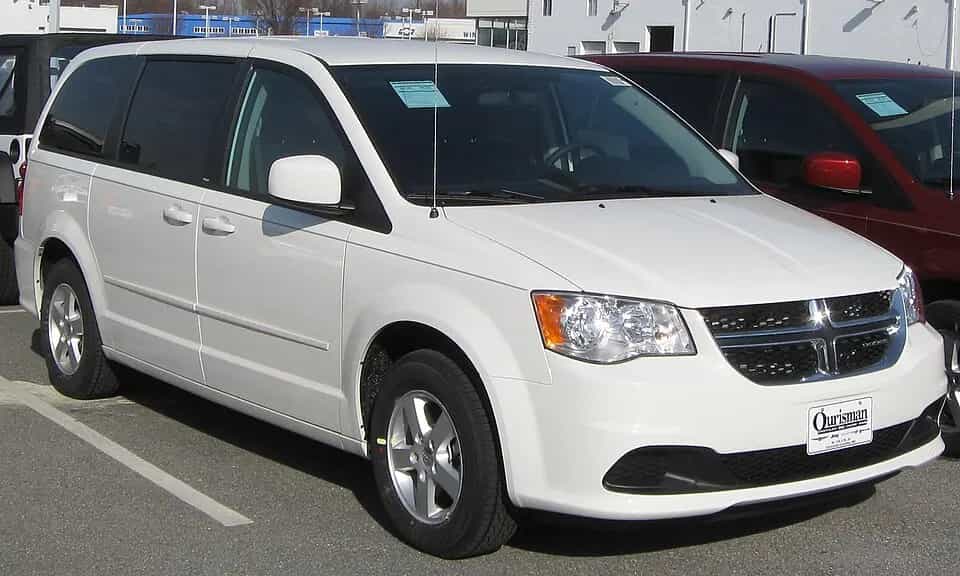
Few vehicles say "American family hauler" as plainly as the Dodge Grand Caravan.
Model profile
The appeal is straightforward: genuine three-row space, the clever Stow 'n Go folding seats, a proven Pentastar V6, and a body-on-nothing-fancy design that is cheap to keep running.
The Grand Caravan name goes back to 1987, but the version relevant to import today is the fifth generation, launched for the 2008 model year on the Chrysler RT platform and sold until the 2020 model year — an unusually long run.
Powertrain and equipment
Pre-2011 cars used the 3.3-litre V6 (roughly 175 hp), the 4.0-litre V6, or the 3.8-litre V6 mated to a four- or six-speed automatic. These are worth avoiding unless the price is right.
US trims ran from the basic SE and fleet-oriented American Value Package up through SXT, Crew, R/T and the sportier GT that closed out the range. Equipment on higher trims included power sliding doors, a power tailgate, tri-zone climate, the Uconnect touchscreen and rear-seat entertainment.
Vehicle selection
Supply in the States is deep. Fleets, rental companies and families all bought these in volume, so you can be selective on year, mileage and condition.
A used Grand Caravan suits large families, ride-share and shuttle operators, and small businesses that need a flexible load bay without stepping up to a full-size van.
Vehicle data
| Body style | Minivan / MPV (C/V cargo variant available) |
|---|---|
| Length | approx. 5,143 mm |
| Wheelbase | approx. 3,078 mm |
| Width | approx. 1,998 mm |
| Seating | Up to 7 (Stow 'n Go) |
| Curb weight | approx. 2,000 kg |
| Engine (typical) | 3.6 L Pentastar V6, petrol |
|---|---|
| Power | approx. 283 hp |
| Torque | approx. 260 lb-ft (352 Nm) |
| Transmission | 62TE 6-speed automatic |
| Drive | Front-wheel drive |
| Fuel tank | approx. 76 litres |
| Generation | Fifth (Chrysler RT platform) |
|---|---|
| Production years | 2008–2020 (Pentastar from 2011) |
| Assembly plant | Windsor, Ontario, Canada |
| Displacement | 3,604 cc |
Values are reproduced verbatim from the existing article table. The documents for the specific vehicle govern.
Pre-purchase review
The Grand Caravan is dependable in the drivetrain but has a handful of well-documented weak spots. The 62TE automatic can develop harsh or delayed shifts if fluid changes are neglected; insist on evidence of transmission servicing. The TIPM (Totally Integrated Power Module) is the most notorious fault — a failing unit causes random electrical gremlins such as fuel-pump relay problems, dead wipers or no-starts.
Germany and Europe
US-market vans run amber front side-marker lamps, a differently calibrated speedometer emphasising mph, and typically lack a rear fog lamp — all items the German TÜV will expect to be addressed.
Expect to convert the headlights to a European beam pattern or fit compliant units, add a rear fog lamp, and confirm the speedometer shows km/h.
USCar Trader services
As a buyer based in Germany, you do not have to inspect the vehicle yourself in the United States or Canada. Within the agreed scope, USCar Trader can coordinate document review, a separately commissioned on-site inspection and purchase processing.
Covered inspection points are agreed in advance. An on-site inspection records condition at the appointment and is not a guarantee.
Next step: Before commissioning, USCar Trader and the customer agree which document, history, inspection and transaction checks suit the vehicle and are included in the service. This records what was actually checked.
Import process
The assessment depends on the specific vehicle and the circumstances of the transaction. Please contact USCar Trader before purchase; we review any possible duty benefit and provide non-binding support. Import VAT and other costs are considered separately.
Questions and answers
Yes. It is left-hand drive, mechanically simple and well supported. With the correct lighting changes and a TÜV individual approval it registers normally in Germany.
No, not automatically. A 0% EU import-duty rate may be available for a vehicle covered by Regulation (EU) 2026/1455 that has US origin and is imported directly into the EU. CETA may apply to a vehicle with preferential Canadian origin. Whether the requirements are met is assessed for the individual case. Please contact USCar Trader before purchase; we review the possible duty benefit and provide non-binding support. Import VAT and other costs are assessed separately.
Import VAT and other taxes or costs are assessed separately under the applicable rules and the circumstances of the individual case. A blanket answer for every vehicle would not be reliable.
The 3.6-litre Pentastar V6 from the 2011 model year onward, ideally 2013 or later once the early cylinder-head issue was addressed.
The TIPM electrical module and neglected 62TE transmission servicing are the two to scrutinise, along with underbody rust on salt-belt cars.
Usually by container or roll-on/roll-off from an East Coast port, with escrow protecting your funds until the vehicle is verified and loaded.
Yes, and it is often registered in Germany as a light commercial vehicle, which can affect tax class — we advise on this case by case.
Available VIN, title and history information can be reviewed in the vehicle profile. USCar Trader can also arrange a separately booked on-site inspection within a scope agreed in advance.
More vehicles